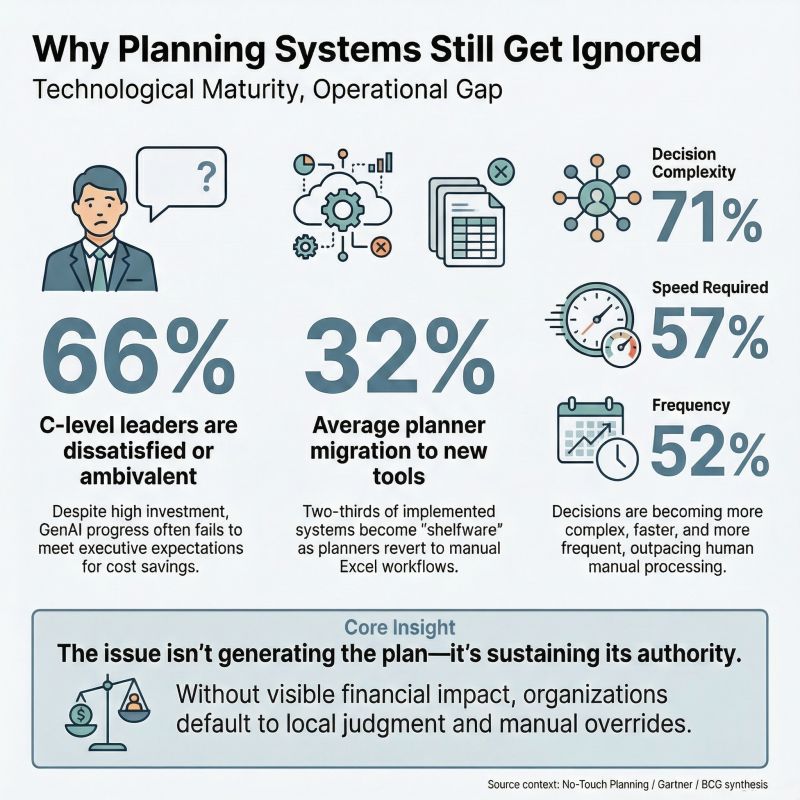
Post 2.1 — Why No-Touch Planning Still Ends in Spreadsheets
No-Touch Planning has been discussed for years as the future of supply chain execution.
Yet in practice, many planning organisations still rely on spreadsheets.
This is often explained as a trust problem.
But the issue is usually more structural.
Planning systems do not all do the same job.
Some mainly consolidate plans.
They collect inputs from different functions, align them, and create a single number for the organisation to work from.
Others are the place where plans are actually formed, adjusted as conditions change, and tested through immediate simulation of operational and financial consequences.
Only the second type moves an organisation materially closer to No-Touch Planning.
And that is where many implementations appear to stall.
Not every planning decision requires the same degree of system sophistication.
In some categories, the room for optimisation is genuinely narrow. Shelf life, production cadence, and other hard constraints already determine most of the answer. In such cases, static rules may be adequate.
In others, they are not.
Where demand variability is high, where SKU and lot complexity matter, and where inventory decisions carry meaningful financial consequences, the gap between static logic and system-led simulation becomes substantial.
That is where regression to spreadsheets destroys the most value.
So the issue is not simply that systems lack flexibility.
It is that organisations rarely distinguish between decisions for which basic control is enough and decisions for which the plan must be actively reshaped within the system itself.
Safety stock illustrates the point.
In volatile and financially material categories, safety stock should not remain a fixed inheritance from legacy logic. It should move as demand moves, as lead times shift, and as inventory positions change. And the implications should be visible immediately for service, inventory, operations, and margin.
In practice, however, something else often happens.
Legacy logic is moved into the system.
Exceptions remain manual.
Final judgement remains external.
And Excel remains the place where confidence is restored.
At that point, the system is not improving planning.
It is formalising an existing manual process.
So the real question is not whether the system can produce a plan.
It is whether, when reality changes, the system is where the plan is genuinely reworked.
Can it absorb change within the planning logic itself?
Can it show the effect on service, inventory, operations, and margin without manual reconstruction?
And can it produce an answer that is genuinely better than manual intervention?
If not, the organisation may plan in the system.
But it will continue to decide in the spreadsheet.
What is easy to automate and what is valuable to automate are not necessarily the same thing.
That distinction is often overlooked.
#SupplyChain #NoTouchPlanning #SCM #PlanningSystems