The Real Bottleneck Is Not the Model.
Over nine posts, I made the case that supply chain decisions are simulation problems — not reporting problems.
But I left out the hardest part.
What happens when the simulation delivers an answer — and the organisation ignores it?
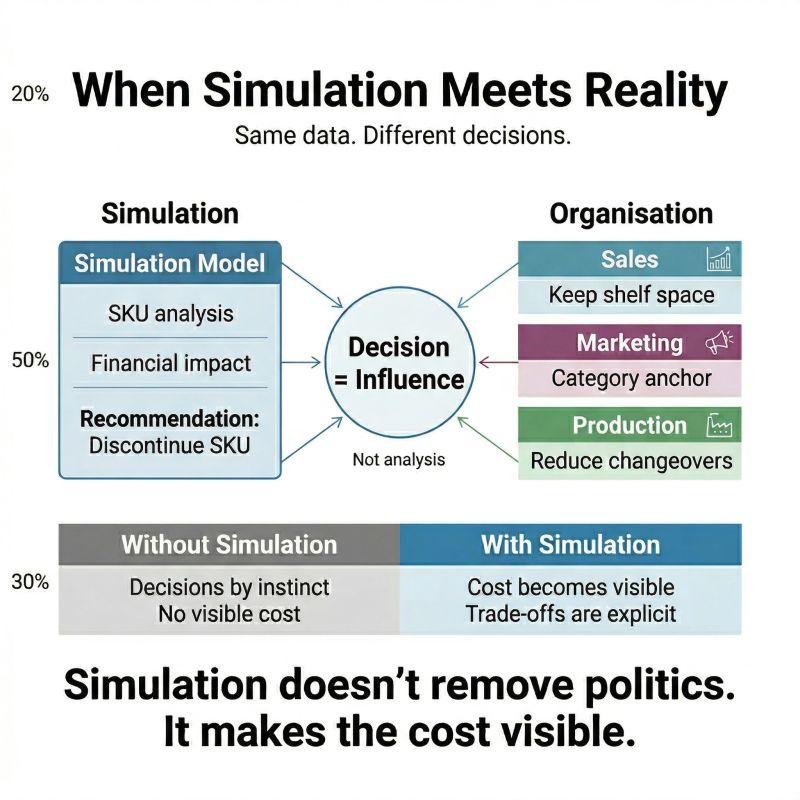
A simulation identifies a SKU that should be discontinued.
The financial impact is modelled. The analysis is sound.
But in the room, the decision is not made on analysis.
Sales says: "We cannot afford to lose shelf space."
Marketing says: "This product anchors the category."
Production says: "Fewer SKUs means fewer changeovers. Let's proceed."
Three functions.
Three KPIs.
Three conclusions from the same data.
And the decision goes to whoever carries the most weight in that room.
The pattern is predictable.
When the result favours their position, functions embrace the model.
"The data confirms what we have been saying."
When it does not, the model is questioned.
"The assumptions do not reflect our reality."
Same model. Same data.
Opposite reception.
I have seen this in Seoul, in California, and in Tokyo.
The language differs.
The structure does not.
So is simulation pointless?
The opposite.
Without simulation, decisions are made entirely on instinct and authority. No reference point.
No cost attached to the choice.
Power operates invisibly.
With simulation, the cost of deviation becomes visible.
The organisation may still choose to keep a loss-making SKU.
But it can no longer pretend the cost does not exist.
The purpose of simulation is not to eliminate organisational politics.
It is to make the cost of politics visible.
That is what separates managing by instinct from managing by intelligence.
This is the final post in this series.
But there is another side to this story.
So far, I have focused on what decisions should be made.
I have not yet addressed what actually happens on the ground.
Why does the planner still open a spreadsheet when an MRP system exists?
Why does the production schedule get rewritten by hand every week?
That will be the subject of the next series.
#SupplyChain #SupplyChainAnalytics #DecisionScience #OperationsStrategy #SupplyChainManagement