Post 2.3 — A Planning System Is Not Yet Intelligence
Many organisations already have a planning system.
That is not the same as having intelligence.
Planning tells you what the rules say should happen next. Reorder points, safety stock, MOQ, production sequences — the system applies the logic it was given.
For stable products, that can work well.
But many of the decisions that shape profit are not resolved by planning logic alone.
Which SKUs should stay and which should go. How a constrained production line should be allocated. Whether a price trade-off is worth accepting. When ageing inventory should be marked down — and by how much.
These decisions sit at the intersection of commercial, financial, and operational judgement. No single function usually owns them. They are settled — well or badly — through cross-functional negotiation.
No single function sees the full trade-off. SCM usually comes closest.
Cost, demand, inventory, capacity, shelf life — these signals all meet there. That is why SCM is often best placed to connect them, simulate the impact of each alternative, and express the trade-off in financial terms that every function can understand.
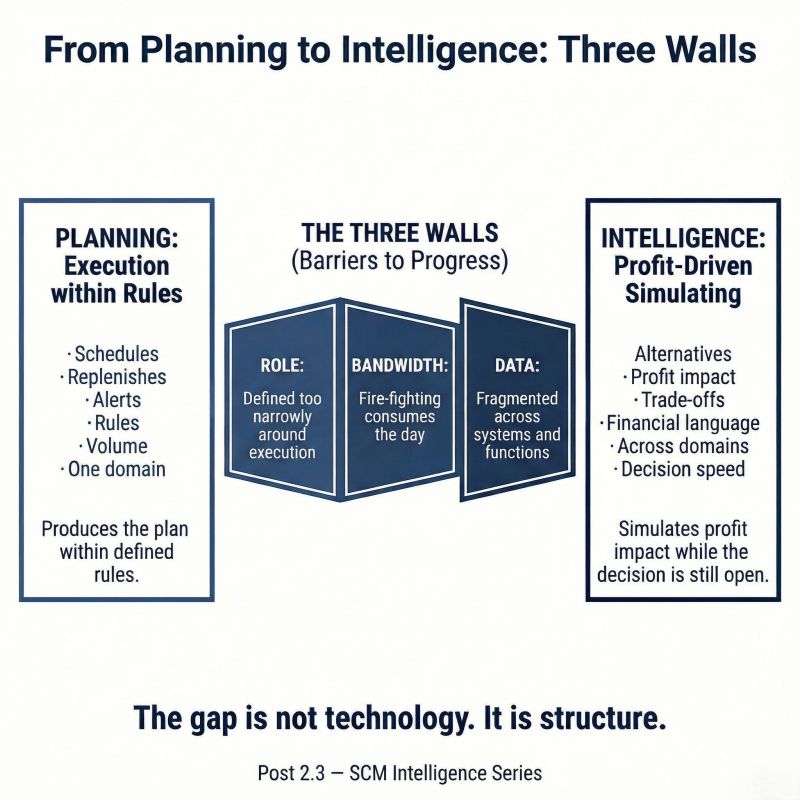
In many organisations, that still does not happen. Three barriers tend to get in the way.
First, the role itself is often defined too narrowly around execution.
Second, bandwidth. Day-to-day planning is consumed by fire-fighting. The work that would do most to protect profit is repeatedly pushed behind the needs of the day.
Third, data. The inputs required for profit simulation usually sit across multiple systems and functions. By the time they are brought together, the decision window has often narrowed or closed.
The planning system does not usually solve this. Some planning systems extend further — into demand consensus, inventory policy, and medium-term balancing. Even then, the hardest questions often remain outside routine planning: not what the plan is, but which alternative protects the most profit.
It schedules. It replenishes. It raises alerts.
But it does not typically tell you which production mix earns the most margin per constrained hour. It does not show what happens to the portfolio if a SKU is removed. It does not compare alternatives and make clear which one destroys the least value.
Those are intelligence questions.
Planning tells you what should happen next within the logic already defined.
Intelligence connects data across domains, evaluates the trade-off, and puts the financial consequence in front of the right people while the decision is still open.
That is what must change.
#SupplyChain #SCMIntelligence #NoTouchPlanning #DecisionScience #OperationsStrategy #SupplyChainManagement