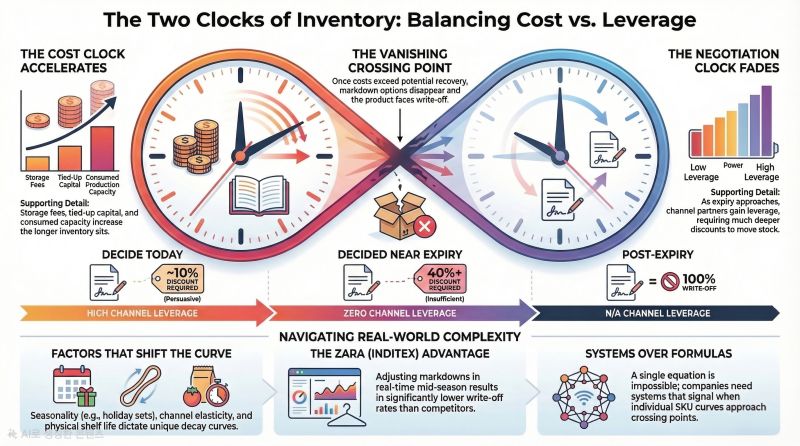
Two clocks are ticking on your inventory.
Most companies only hear one.
Whilst inventory sits in a warehouse, two clocks tick simultaneously.
The cost clock: storage fees, tied-up capital, production capacity consumed. These accelerate over time.
The negotiation clock: when shelf life is comfortable, 10% off can persuade a channel partner. When expiry looms, 40% won't suffice. The channel holds all the leverage.
These two clocks move in opposite directions.
The longer you hold, the higher your costs. The longer you hold, the weaker your hand.
Is it cheaper to decide now, or later?
Inditex — Zara's parent — grasped this early, adjusting markdown timing in real time, mid-season. Widely credited as why their write-off rates are dramatically lower than competitors'.
Food is harsher. Fashion has outlet stores as a fallback. Food has a hard deadline: the expiry date. Once the curves cross, your options vanish.
Put the numbers on the same table: a 10% discount today reduces margin by a known amount. Waiting 30 days means costs accumulate, the required discount deepens, and channel acceptance falls.
When these figures sit side by side, no one needs to argue on instinct.
Simple concept. But in practice, you hit a wall.
New launches carry genuine demand uncertainty. Established products behave differently depending on lifecycle stage.
Let's be frank: products that become excess inventory are overwhelmingly the ones that never found their market. The forecast was wrong from the start. That isn't a markdown problem. It's a "why did we produce this much?" problem.
Seasonality matters. Ice products face a cliff once summer passes. Holiday gift sets are finished the day after the holiday. In-season versus out-of-season draws entirely different curves.
Channels matter. Online shows high price elasticity. Supermarkets impose listing conditions. Convenience stores enforce tight shelf-life rules. The same discount produces completely different responses.
Shelf life matters. Thirty days on a 12-month ambient product is comfortable. Thirty days on a 14-day fresh product is a crisis.
And these are not the only variables. The same SKU can approach write-off at one warehouse whilst out of stock at another. Imports with months-long lead times mean curves cross before any decision is possible. Temperature constraints, supplier return terms, warehouse contract changes — the real-world variables far exceed what textbooks list.
Product type × lifecycle × season × channel × remaining shelf life — plus location, procurement structure, storage constraints, and more.
Two curves, one table. Simple concept.
But every product, channel, season, and location draws a different curve.
A single formula for all of this? Impossible.
What's needed is not a universal equation — but a system that draws each curve individually and signals when a crossing point approaches.
Next post: what that system looks like.
#InventoryManagement #SandOP #FMCG #SCM #ProfitOptimization