Most Supply Chain Decisions Are Simulations, Not Reports
Most supply chain decisions are treated as reporting problems.
They are not.
They are simulation problems.
Yet much of today’s analytical infrastructure
is still optimised for reporting rather than simulation.
Across my previous posts, I argued that:
- Profit leakage in supply chains is often structural
- SCM organisations typically operate in volume, while executives decide in profit
- Even a markdown decision becomes computable once framed as two opposing cost curves
But the harder question is this:
Can this work at scale?
Not as a one-off project.
As a living operating capability.
In practice, many organisations find that their current analytical infrastructure was not originally designed for this kind of simulation.
When capital costs rise, inventory becomes a financial liability.
Every day an unsold unit remains in the warehouse, it quietly accumulates cost.
Yet many organisations still struggle to compute this at the SKU level.
Consider three common decisions.
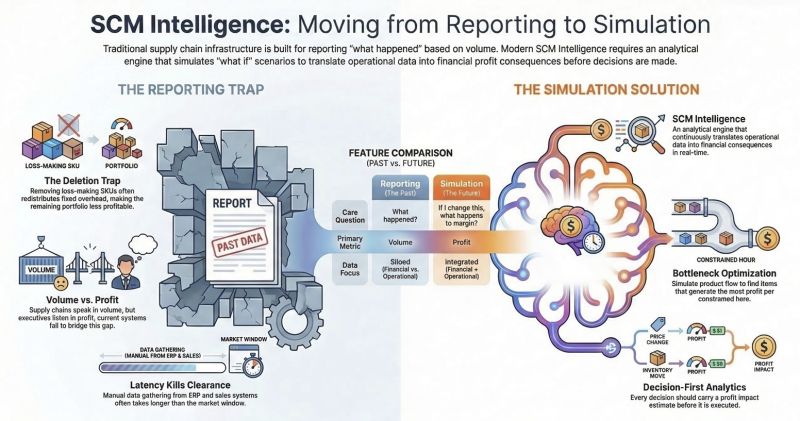
1. The Discontinuation Trap
Some SKUs destroy value.
The instinct is to discontinue them.
But fixed costs rarely disappear — they redistribute.
Removing a loss-making SKU can sometimes reduce the profitability of the remaining portfolio.
These decisions require simulation of cost and capacity reallocation.
2. The Product Mix Problem
High margin does not always mean high profit.
When bottlenecks exist, a lower-margin product that flows efficiently may generate more profit per constrained hour.
This is not scheduling.
It is portfolio optimisation.
Yet most systems split the data:
Financial systems → economics
Operational systems → constraints
The model needs both.
3. The Markdown Window
The optimal clearance timing is often computable.
The challenge is speed.
Design cost sits in PLM.
Actual cost in ERP.
Discount history in sales.
Inventory age in warehouse systems.
By the time the analysis is complete, the answer is often already outdated.
These are only three examples.
In practice, many supply chain decisions — safety stock, channel allocation, price–mix–volume analysis — are fundamentally simulation problems, not reporting queries.
Traditional data platforms answer:
“What happened?”
But supply chain decisions increasingly require:
“If we change this now, what happens to margin tomorrow?”
That is on-demand profit simulation.
That is SCM Intelligence.
The models themselves are not new.
What is changing is the infrastructure that can run them across entire portfolios and decision cycles.
The real question is:
Is your organisation ready to manage supply chains by profit — not just by volume?