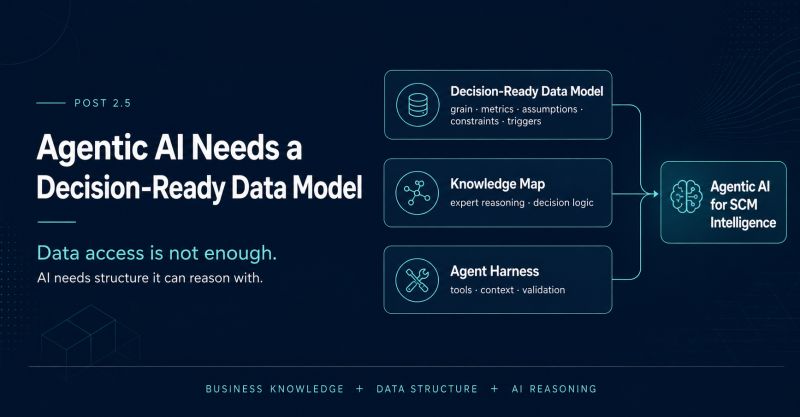
Post 2.5 — Agentic AI Needs a Decision-Ready Data Model
In my last post, I wrote about intelligence reaching the decision.
But before AI can prepare a decision, it has to understand the logic behind that decision. That requires more than data access.
Many AI projects begin by connecting the model to ERP, planning, inventory, sales, production, cost, and master data. Necessary, but not sufficient.
A forecast is not an order. A safety stock target is not inventory. A threshold is not an objective truth; it is a decision rule created under specific business conditions.
If AI does not understand those differences, it can bring the right number into the wrong context, treat assumptions as facts, or explain a symptom as if it were the root cause.
Not because the model is weak, but because the business logic underneath the data is not explicit enough.
That is why Agentic AI needs a decision-ready data model.
Over the years, I accumulated project material and operating experience across SCM transformation, profitability analysis, inventory decisions, supply planning, commercial analytics, pricing strategy, and demand-shaping mechanisms.
But raw experience is not enough for AI. It has to be reorganised into a structure the model can reason with.
So I consolidated fragmented project logic, refined the decision criteria, validated the reasoning against operational data, and built it into a knowledge map.
Technically, this sits at the intersection of knowledge engineering, semantic modelling, Agentic RAG, and agent harness design.
Practically, it means turning expert judgement into a reusable decision system.
A document library stores what people wrote.
A knowledge map structures how experts think.
For each decision area, it defines the data grain, metric meaning, threshold assumptions, scenario constraints, and action triggers.
High inventory is not just stock cover. It depends on shelf life, sales velocity, margin, channel options, disposal cost, and timing of action.
This is why more data layers are not the answer.
Traditional DW structures often grow in the opposite direction: more marts, more extracts, more departmental views, and more local definitions. Each layer may have been created for a reason, but together they make the logic harder to trace.
For Agentic AI, the direction has to be different: fewer meaningless layers, clearer semantic structure, a knowledge map that carries expert reasoning, a data model that carries business meaning, and an agent harness that controls which knowledge, tools and validation steps the AI can use.
This is where AI moves from retrieving data to preparing analysis.
Not because the model is magically smarter, but because the decision logic has finally been made visible.
That is the architecture I am building for SCM Intelligence: business knowledge, data structure, and AI reasoning connected as one decision system.
#SupplyChain #SCMIntelligence #AgenticAI #DataArchitecture #DecisionScience