Post 2.6 — Many AI Agents Can Answer Questions. Fewer Know What to Look For.
I have been building a supply chain agent — not a chatbot, not a natural-language SQL layer, and not another dashboard with a conversational front end.
The question I designed it for was simple:
Which customer order patterns are changing before the forecast miss becomes visible?
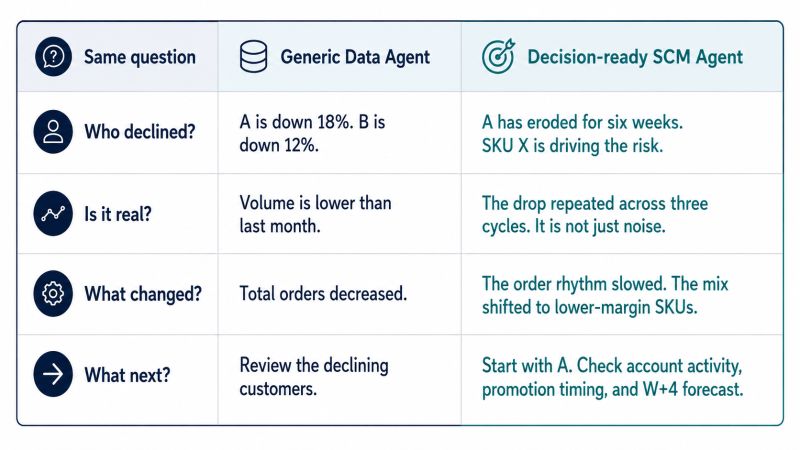
A generic data agent can answer “Who declined this month?” or “Which SKU moved?”
Useful — but not enough.
In supply chain, the first answer is rarely the decision signal.
A customer rarely stops ordering overnight.
The pattern moves first.
A smaller order.
A skipped cycle.
A weekly rhythm becoming bi-weekly.
A quiet SKU mix shift.
Total volume may still look acceptable.
Then, weeks later, the forecast miss appears.
By then, the signal was not new.
It was only unnoticed.
That was the lesson that took the longest to absorb while building the agent.
The issue was not whether it could access the data.
It could.
The issue was whether it knew what was worth looking for.
The contrast is concrete:
“Customer A declined 18% this month.”
versus
“Customer A has eroded for six weeks. The decline started with cadence, then SKU mix. SKU X is now driving the risk.”
The first is an answer.
The second is a signal.
Same data.
Different unit of intelligence.
This changes the planner’s work.
Without the agent, the planner spends too much time finding the signal.
With the agent, the planner spends more time deciding what the signal means.
Why is this happening?
Is it commercial?
Is it promotional?
Is it account-specific?
Is it something the data cannot yet explain?
That is where human judgement matters.
The agent brings analytical depth at scale — full portfolio scanning, consistent criteria, and multi-dimensional pattern detection.
The planner brings what the data does not contain — customer politics, commercial intent, account-specific exceptions, and operational constraints not yet captured anywhere.
Neither is enough alone.
An agent without operating knowledge creates noise.
A planner without system coverage misses early signals.
Useful Agentic AI is not built by connecting an LLM to a data warehouse.
Data access lets the agent answer.
Operating knowledge tells the agent what to look for.
That is the idea behind Knowledge-Orchestrated Agentic Analysis™ — not an agent that simply talks to data, but an analytical structure where operating knowledge guides attention.
Many agents can answer questions.
Fewer know what to look for.
#SupplyChain #SCMIntelligence #AgenticAI #DataModeling #DecisionScience