Loss-making SKUs aren't a discovery problem. They're a neglect problem.
Every company knows it has unprofitable products. The real issue is that no one distinguishes what kind of loss they're dealing with.
After years in food and FMCG supply chains, I'll say this plainly: lump all loss-making SKUs into one bucket labelled "unprofitable," and you lose the ability to fix any of them.
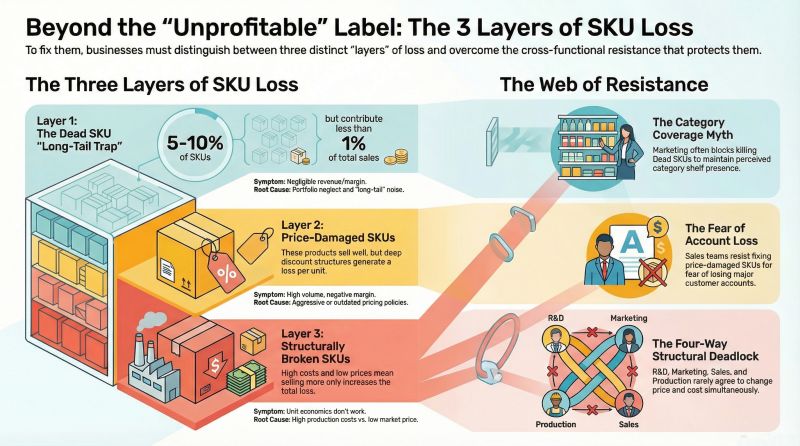
SKU losses come in three layers.
𝗟𝗮𝘆𝗲𝗿 𝟭: 𝗗𝗲𝗮𝗱 𝗦𝗞𝗨𝘀. No meaningful revenue. No margin. Yet still in the portfolio. Typically 5–10% of SKUs, under 1% of sales. Customers wouldn't notice if they vanished. Your warehouse would.
Each one is invisible on its own — too small to fight over. So nobody does.
This is the long-tail trap. Individually, these are noise. But stack dozens of them up and they quietly occupy warehouse space, production slots, and transport capacity. In aggregate, they erode your margin structure. And this tail never shortens itself.
𝗟𝗮𝘆𝗲𝗿 𝟮: 𝗣𝗿𝗶𝗰𝗲-𝗱𝗮𝗺𝗮𝗴𝗲𝗱 𝗦𝗞𝗨𝘀. These sell. Sometimes well. But discounts have deepened to the point where every unit sold is a loss. The product isn't the problem. The pricing policy is.
𝗟𝗮𝘆𝗲𝗿 𝟯: 𝗦𝘁𝗿𝘂𝗰𝘁𝘂𝗿𝗮𝗹𝗹𝘆 𝗯𝗿𝗼𝗸𝗲𝗻 𝗦𝗞𝗨𝘀. Demand exists. The product moves. But costs are too high and realised prices too low — or both. Selling more doesn't fix this. It makes it worse.
Analysis gets you this far. The real problem is what comes next.
𝗪𝗵𝘆 𝗰𝗮𝗻'𝘁 𝗮𝗻𝘆𝗼𝗻𝗲 𝗳𝗶𝘅 𝘄𝗵𝗮𝘁 𝘁𝗵𝗲𝘆 𝗰𝗮𝗻 𝘀𝗲𝗲?
Each layer has a different resistance structure.
Kill a dead SKU → Marketing blocks it. "Category coverage." And since it's long-tail, the benefit looks trivial. Too small to fight. So it stays.
Fix pricing → Sales blocks it. "We'll lose the account."
Structurally broken SKUs are the heaviest. Both levers must move at once. Raise prices → Sales resists. Cut costs → Three functions resist simultaneously. R&D: "Recipe changes compromise the sensory profile." Marketing: "Taste changes damage the brand." Production: "New specs drop yields."
Both doors need opening, but four or five people hold the keys — and no one turns theirs first. These SKUs sit unchanged for years.
But there's a deeper issue still.
This classification requires design-stage cost targets from PLM, actual costs from ERP, discount data from Sales, inventory turns from Logistics. Different systems, different time horizons — all needing to converge.
"What cost, price, and volume was this product designed for?" "What's drifted since — cost, price, or volume?"
Comparing the starting point with today is the only way to see where things broke. But even with the data assembled, judgement is still required. Context, estimation, interpretation — all manual.
Gathering data: manual. Making the call: manual. This can be a one-off project. It cannot become a monthly rhythm.
The distance between seeing once and seeing continuously — that determines how long a loss-making SKU survives.