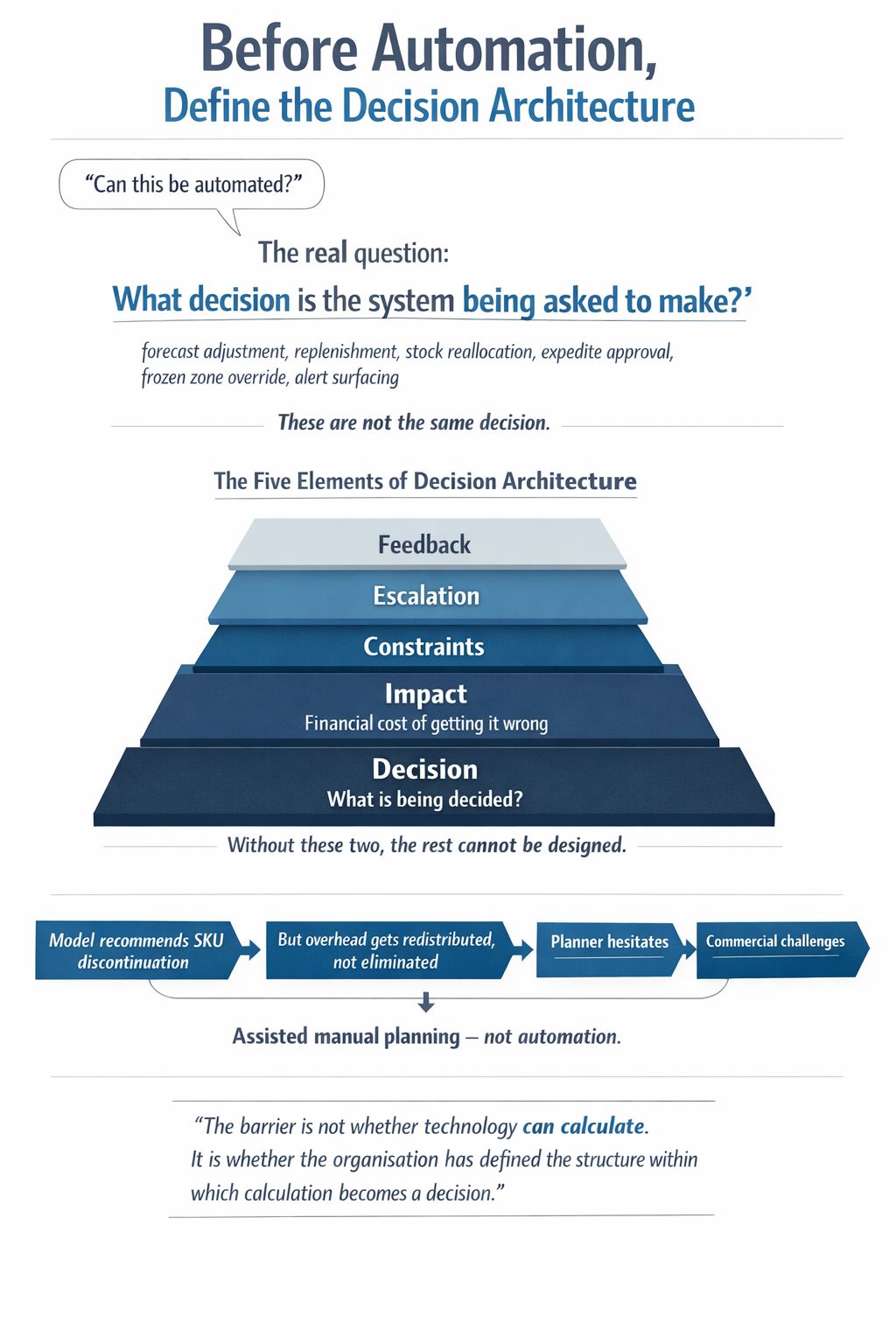
Post 2.2 — Before Automation, Define the Decision Architecture
One of the most common questions in supply chain transformation is this:
Can this decision be automated?
It sounds reasonable.
But it may not be the first question.
A more fundamental one comes earlier:
What decision, exactly, is the system being asked to make?
That is not semantics.
Much of what gets described as No-Touch Planning is still too loosely defined to become operationally credible.
The issue is often not the algorithm, but the decision architecture around it.
Is the system adjusting forecast?
Recommending replenishment?
Reallocating constrained stock?
Approving an expedite?
Breaking a frozen zone?
Or simply surfacing an alert?
These are not the same decision.
Yet they are often treated as one automation agenda.
A system cannot meaningfully automate a decision that the organisation itself has not clearly defined.
For a planning decision to become operationally credible, five things need to be explicit. The first two are foundational.
First, the decision itself.
What is being decided?
Second, the impact.
Not in KPI terms, but in margin terms.
What is the financial cost of getting this decision wrong?
Service loss, excess holding cost, expediting premium, and production distortion need to be expressed in one currency, not scattered across departmental scorecards.
Supply chain decisions rarely fail in units first.
They fail in money.
If impact is still described in cases, days, or percentages, the decision architecture has no common language — and no real basis for escalation.
Third, the constraints.
What must not be broken, even if the model finds an attractive answer?
Fourth, the escalation path.
What can run automatically, and what still requires planner, cross-functional, or executive intervention?
Fifth, the feedback loop.
How will the organisation learn from overrides, exceptions, and outcome gaps?
Without those five elements, automation remains conceptual.
The system may still produce outputs.
But the operating logic around those outputs remains incomplete.
The model recommends discontinuing a SKU.
The analysis looks sound.
But no one has asked whether the overhead allocated to that SKU disappears with it — or simply gets redistributed across what remains.
The planner hesitates.
Commercial challenges it.
Finance tries to reconcile it afterwards.
What looked like automation becomes another version of assisted manual planning.
Not because the model was necessarily wrong.
But because the decision was never architected to absorb its own consequences.
This may be why No-Touch Planning is often harder than expected.
The real barrier is not simply whether the technology can calculate.
It is whether the organisation has defined the structure within which calculation becomes a decision.
#SupplyChain #SupplyChainPlanning #NoTouchPlanning #SCM #SOP #DecisionMaking #OperatingModel #DigitalTransformation