In the previous post, we looked at the Deletion Trap.
A product can appear unprofitable in a report,
yet still contribute to the system.
But even when a product is profitable,
the next trap is waiting.
Imagine a factory operating close to full capacity.
Not every product can be produced at the same time.
Some products must wait.
At that moment, a simple rule often emerges.
Produce the product with the highest margin per unit.
At first glance, the logic seems sound.
Higher margin should mean higher profit.
But this logic quietly assumes something that is rarely true.
It assumes capacity is unlimited.
When capacity becomes constrained, the economics change.
Profit is no longer determined only by margin per unit.
It is determined by how efficiently a product uses the constrained resource.
Consider two products.
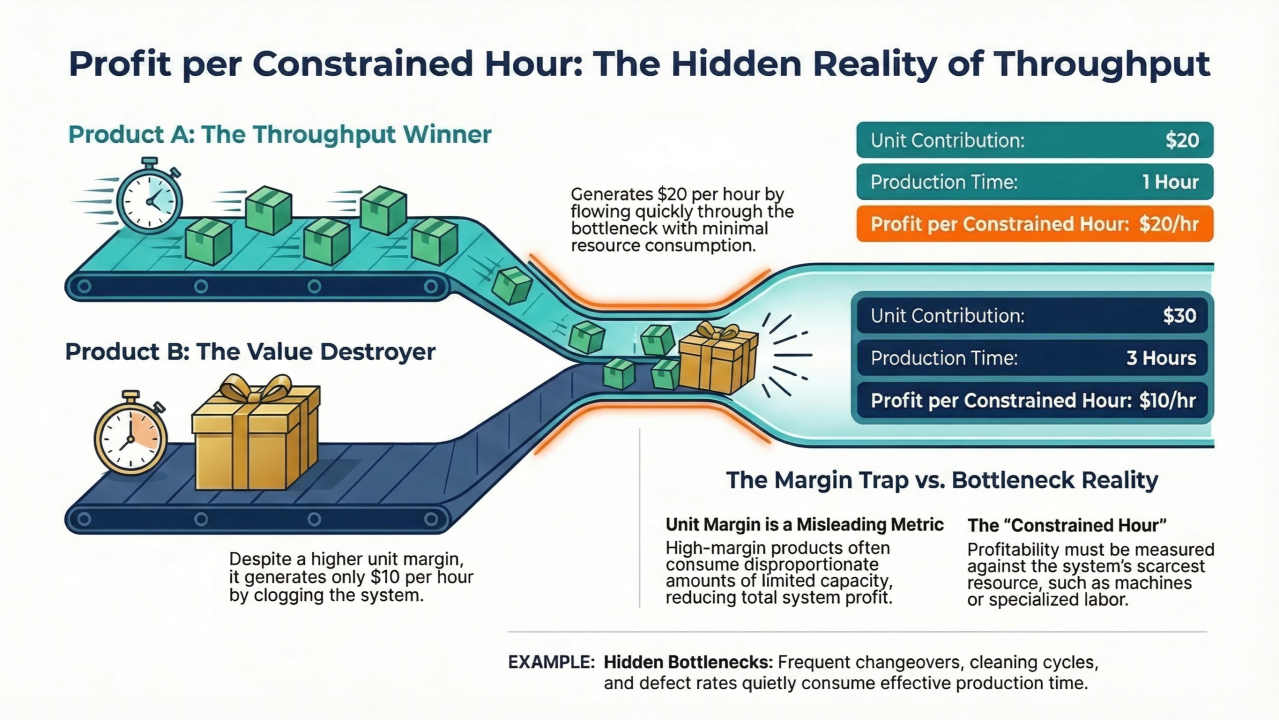
[Product A]
Contribution per unit - $20
Production time: 1 hour
[Product B]
Contribution per unit: $30
Production time: 3 hours
If we rank products by margin per unit, Product B appears superior.
But if the bottleneck resource is production time, the calculation changes.
Product A generates $20 per constrained hour.
Product B generates $10 per constrained hour.
In a constrained system, producing B instead of A destroys value.
The factory spends more time to generate less profit.
In some cases, this single decision — which product goes first —
determines whether the factory reports a profit or a loss.
Yet many organisations still prioritise production using unit margin.
Because financial reports describe profitability per unit,
while operations experience reality per hour.
Once the constraint becomes visible, the decision rule changes.
The question is no longer:
Which product has the highest margin?
The question becomes:
Which product generates the most profit from the scarce resource of the system?
Identifying that resource is not always straightforward.
Sometimes it is a production line.
Sometimes it is a specialised machine.
Sometimes it is warehouse capacity or logistics throughput.
And sometimes the constraint hides inside the production process itself.
In food and FMCG manufacturing, for example, changeover time can quietly become the real bottleneck.
Products that require frequent cleaning or recipe changes consume far more effective capacity than their scheduled production time suggests.
Add higher defect rates or quality losses, and the gap widens further.
The visible production time is not the real production time.
Which means some products quietly consume far more of the constrained resource than others.
And once that happens, margin per unit stops being a reliable guide.
Profit must be evaluated per constrained hour.
But knowing the correct ranking is only the beginning.
Changing the production mix reshapes the rest of the system.
Inventory levels adjust. Fulfilment patterns shift. Cost absorption moves across the portfolio.
The real question becomes:
Can you understand those consequences before committing to the change?
Because at that point, the problem is no longer scheduling.
It becomes a system decision.
Many modern planning platforms can run sophisticated allocation and scenario analyses.
But most optimisation models still evaluate profitability per unit.
And that assumption quietly breaks down when capacity becomes constrained.
Because factories do not earn profit per unit.
They earn profit per constrained hour.
Which means the real optimisation problem is not simply:
Maximise margin.
It is:
Maximise profit generated from the system’s scarce resource.
And that requires seeing the supply chain as a connected economic system, not just a set of local optimisation problems.
That will be the focus of the next post.
#SupplyChain #SupplyChainManagement #OperationsStrategy #SupplyChainAnalytics #DecisionScience