SCM Agentic Intelligence

Your ERP tells you what happened. We simulate what should happen next.

Independent SCM simulation platform that turns cost-structure visibility into executable profit decisions — without replacing your existing systems.

8
Analytical Axes
6
AI Agents
4
Architecture Layers
<3min
Optimisation Time

The structural traps hiding inside your supply chain

These are not failures of effort or talent. They are architectural defects in how decisions connect to financial outcomes. In every portfolio we have examined — across Korea, the US, and Japan — these patterns repeat.

15%
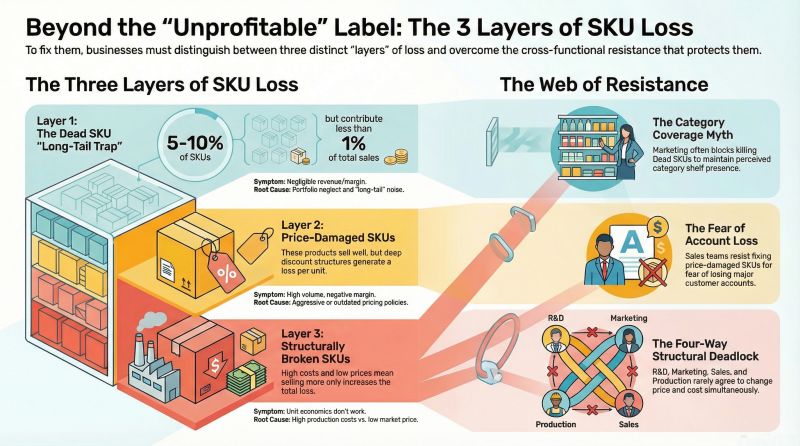
of SKUs actively destroying value in a typical portfolio — not a rounding error, a structural feature
31%
of logistics inventory sitting beyond 90 days — capital trapped, options narrowing daily
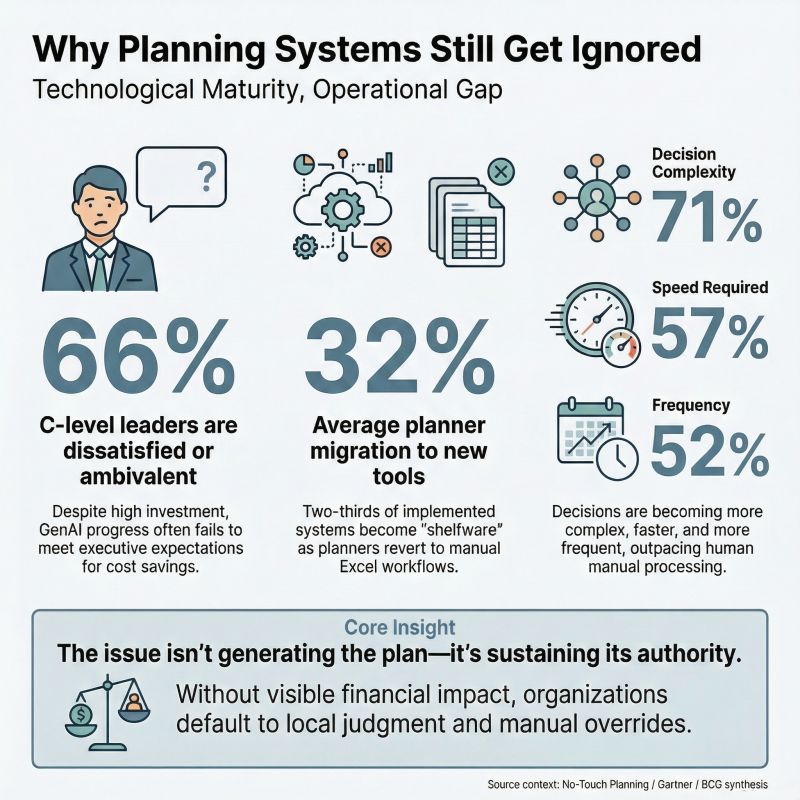
66%
of C-level leaders dissatisfied with AI progress — the gap is not technology, it is decision architecture

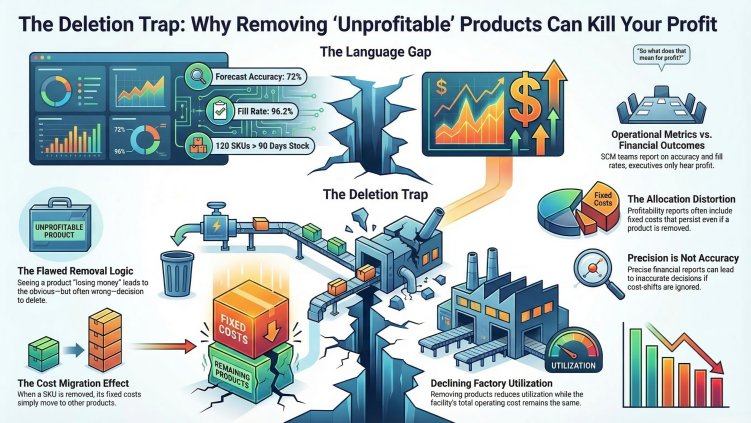
The Deletion Trap

You removed the loss-making SKU. Costs didn't shrink — they redistributed across remaining products, creating new losses where none existed before.

What happens: CEBIT reports 83 SKUs as loss-making. You discontinue them. But PROCO analysis reveals many were actually generating cash. The overhead they absorbed migrates to survivors. The upside was capped at exactly that SKU's contribution. The downside is open-ended.
Overhead reallocation
📊

The Forecast Obsession

Spending months improving forecast accuracy by 2%, while structural margin leakage from MOQ conflicts, pricing erosion, and bottleneck misallocation goes entirely undiagnosed.

What happens: The organisation invests in ML-based demand forecasting. Accuracy improves from 70% to 72%. Meanwhile, overstock from MOQ-demand mismatch, promotional discounts exceeding the Golden Zone, and sub-optimal production sequencing silently destroy margin across hundreds of tail SKUs. No one measures the ROI of forecast improvement against the cost of structural neglect.
Misallocated effort
📋

The Spreadsheet Ceiling

Your planner manages 500 SKUs × channels × lots in Excel. The real question isn't what they're doing — it's what they structurally cannot see.

What happens: Demand changes in the spreadsheet. But the supply plan doesn't auto-recalculate — the planner manually re-runs it hours later. That time gap is where stockouts and overstock are born. Lot-level shelf-life matching across temperature zones, channel-specific expiry rules, and cross-site rebalancing exceed human verification capacity at any meaningful scale.
Cognitive limit
🔄

The Margin Inversion

The highest unit-margin product consumes disproportionate bottleneck time. Prioritising it actually destroys total profit.

What happens: Product B has $30 margin vs. Product A's $20. Every scheduler picks B first. But B takes 3 hours on the bottleneck while A takes 1. A generates $20/hr; B generates $10/hr. Prioritising B costs $600/week in a real scenario. Without T_eff (contribution per bottleneck-hour), the inversion is invisible — and it persists for years.
T_eff blindness

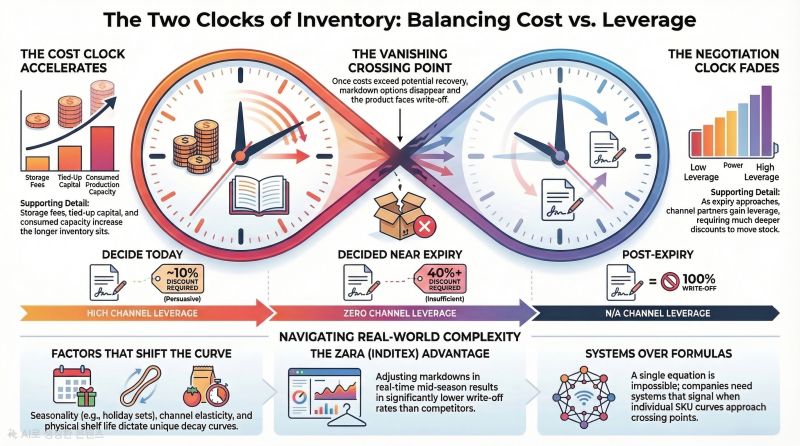
The Two Clocks

Holding cost accumulates while negotiation leverage declines. Once the curves cross, your options vanish.

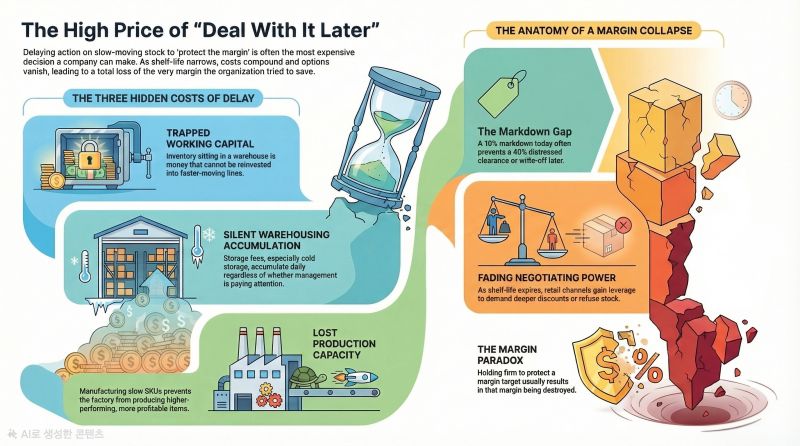
What happens: Three months ago, a 10% markdown would have cleared the stock. Sales said "let's park it." Marketing said "wait until it stops moving." Today the shelf life is critical, 40% off won't move it, and the channel isn't interested. They held firm to protect the margin. The margin was destroyed anyway. Product × lifecycle × season × channel × location — each combination draws a different curve. A single formula is impossible.
Disposition timing
🏗

The Fragmented Simulation

Your deletion model assumes freed capacity is absorbed. Your capacity model assumes the current mix holds. Your inventory model assumes the current plan is stable. Change one and the rest are already wrong.

What happens: Different teams run different models, in different systems, on different cycles. Each model is internally consistent — but their boundary conditions are incompatible. Deleting an SKU changes the capacity mix. Changing the mix changes inventory behaviour. Changing inventory changes markdown timing. Every simulation's output is the next simulation's input. Without a connected chain, each "optimisation" is a local improvement that distorts the whole.
Model disconnection

8 analytical axes, one continuous workflow

Every inventory position is evaluated not as cost, but as an investment asset — measured by its financial contribution across eight dimensions.

Monitor
Diagnose
Simulate
Action & Track
AXIS 01
Profitability
Is this inventory making money?
AXIS 02
Turnover
How fast does it sell?
AXIS 03
Variability
Can demand be predicted?
AXIS 04
Structural Conflict
Why does overstock occur?
AXIS 05
Space & Cost
What does it cost to hold?
AXIS 06
Service Level
What is the stockout risk?
AXIS 07
Network Allocation
Is it in the right place?
AXIS 08
Disposition
Dispose or hold — which is better?

Decision metric principle: MC/BH for short-term scheduling (fixed costs don't change with sequencing). PROCO for portfolio decisions (captures SKU-specific fixed costs). CEBIT for reporting only — never for decisions.

4-Layer Intelligence Architecture

L4
Execution Handoff

Confirmed daily production → API to APS/ERP → MES. Human-in-the-Loop: the planner always has the final word.

L3
UI & AI Interface

Streamlit dashboard + Cortex AI Agent. Natural language → mathematical constraints. Scenario comparison in seconds.

L2
Optimisation Engine

LP/MIP solver on Snowflake SPCS. Objective: maximise Σ(MC/BH × volume). 500 SKU × 10 sites × 14 days in under 3 minutes.

L1
Unified Data

CDC → Dynamic Tables. Real-time Cost Table: SKU × channel × site PROCO. Cost Drivers auto-refreshed.

Zero Data MovementCompute goes to data, not the other way round
AI as TranslatorShop-floor language ↔ mathematical constraints
Intelligence LayeringAdd a brain on top. Don't rip and replace.

SCM Intelligence as a Service

Each subsidiary building its own AI system faces local talent constraints and capability limits. A centralised service model eliminates this barrier.

Central Intelligence Hub

Global data integration, simulation engine operation, Impact alternative generation, algorithm refinement. One team serves all subsidiaries from a single cloud platform.

Local Decision Nodes

Each subsidiary's planner receives pre-computed Impact alternatives, interprets them in local context, selects the preferred scenario, and executes. No local AI expertise required.

Feedback Loop

Execution results flow back to the Hub. Post-Game Analysis compares predicted vs. actual outcomes. Algorithms learn continuously. Override patterns are studied and absorbed.

Why this model works: Short lead-time environments receive capacity-based production mix scenarios. Long lead-time environments receive global parts allocation scenarios. Same platform, different outputs — tailored to the operational reality.

Service Channels

STREAMLITStructured reports: auto-generated diagnostics, KPI monitoring, visual scenario comparison
CORTEX AIUnstructured deep analysis: natural language query → data retrieval → analysis → recommendation
API HANDOFFExecution bridge: confirmed optimisation results auto-transmitted to existing APS/ERP

Decision Metric Principle (이원화 원칙)

Decision TypeMetricRationale
Production scheduling
(daily mix)
MC / BHOnly variable costs change with sequencing order. Including fixed costs in the objective function creates distortion.
Portfolio decisions
(delete / keep / reprice)
PROCOCaptures SKU-specific fixed costs: listing fees, promotions, dedicated overheads. MC alone cannot see these.
Enterprise reportingCEBITReference only. Never for decisions — indirect cost allocation makes it structurally misleading for action.

Six autonomous agents, one unified platform

Each agent diagnoses, simulates, and recommends — with full financial impact visibility. The planner confirms. The system executes.

AGENT 01

SKU Rationalisation

Automatically diagnoses the entire SKU portfolio: where money leaks, why it leaks, how severe it is, and what to do. Classifies every SKU into Deletion / Rationalisation / Normal with Track assignment.

Key logic: MC/PROCO layered screening → demand health scoring (Green/Yellow/Red) → Deletion Trap simulation with overhead reallocation modelling → NPI gate assessment
AGENT 02

Demand Validation

Detects anomalous demand patterns, corrects ML over/under-prediction, and traces forecast error back to root causes — promotion miss, calendar gap, or POG omission.

Key logic: YoY + trailing-3M comparison → weekday/month-start bias detection → channel-level MAPE/Bias tracking → 4-quadrant demand pattern classification (Steady/Seasonal/Odd/Random)
AGENT 03

Safety Stock Optimisation

Dynamically recalculates target inventory using a 3-axis classification (order frequency × CV × cycle regularity), replacing legacy fixed parameters with statistically grounded, tier-differentiated policies.

Key logic: Aging ratio (elapsed ÷ shelf life × 100) for overstock detection — auto-adjusts across temperature zones. Periodic Review model with MOQ constraints. Winsorised σ for high-CV tails.
AGENT 04

Production Mix Optimisation

When capacity is constrained, simulates the optimal product mix using T_eff (MC per bottleneck hour) — not unit margin. Exposes margin-inversion traps invisible to traditional scheduling.

Key logic: LP/MIP solver → Maximise Σ(MC/BH × volume) subject to demand, bottleneck capacity, shelf-life netting, MOQ, changeover. Switchable objective functions (margin → fill rate → claims).
AGENT 05

Deletion Timing

For confirmed loss-making SKUs, simulates the optimal discontinuation window — including fixed-cost redistribution impact, remaining inventory disposal, and dedicated raw-material run-down.

Key logic: Deletion Trap simulation (mandatory) → Two Clocks analysis (holding cost vs. leverage decay) → BOM version mapping → PLAN/CONFIRM milestone auto-alerting
AGENT 06

Disposition Optimisation

For ageing and slow-moving inventory, calculates the optimal markdown / channel-switch / write-off combination using NRV-based TCO comparison and category-specific Golden Zone analysis.

Key logic: TPD-PROCO correlation → Golden Zone identification (profit amount + margin rate simultaneously maximised) → B2C promotion vs. B2B liquidation vs. disposal TCO comparison

Technology, timeline, and proven results

Built on Snowflake AI Data Cloud. Designed for elastic simulation, not static reporting.

Technology Stack

Every component runs where the data lives — no extraction, no replication, no latency.

Data Platform
Snowflake AI Data Cloud
Unified DW, Dynamic Tables, Marketplace (freight rates, FX, commodities, climate)
AI / LLM
Snowflake Cortex AI
Cortex Analyst + Search + Complete. Natural language agent orchestration
Optimisation
SPCS + PuLP/Gurobi
LP/MIP production mix optimisation. Elastic compute — scales for minutes, costs stop after
UI Layer
Streamlit
Monitor → Diagnose → Simulate → Action workflow. Scenario comparison dashboard
Planning System
Zionex GSCM
Weekly S&OP, MRP, PSI. System of Record for supply planning
Execution
SAP / Oracle EBS + MES
Transaction processing, production execution. Snowflake sits above, not instead of
Automation
Power Automate + UiPath
Orchestration conductor + GUI automation for legacy ERP interfaces
Future Path
RelationalAI
Knowledge graph + prescriptive reasoning. SKU-site-supplier-channel-BOM-equipment ontology

Execution Roadmap

Phase-gated delivery. Each phase delivers a complete, usable capability — not a partial feature.

Phase 1 · Q1–Q2

Diagnostic Services

Data model construction + Agent build → Analysis service delivery + Feedback improvement cycle for each agent.

SKU Rationalisation Demand Validation Safety Stock
Phase 2 · Q3–Q4

Optimisation Services

Production mix optimisation with LP/MIP solver. Deletion timing with overhead simulation. Disposition with Golden Zone analysis.

Production Mix Deletion Timing Disposition
Phase 3 · Year 2

Autonomous Operations

Daily S&OE profit optimisation with overnight Snowflake → Zionex sync. Factory sequencing PoC for high-changeover plants. Multi-objective function switching.

S&OE Daily Sync FP Sequencing PoC RelationalAI

Cut-over principle: Each phase replaces a complete workflow — not a partial feature. If a planner still needs to open Excel to finish the task, adoption fails. Even during phased rollout, the user experience must be: "This task no longer requires a spreadsheet."

Expected Impact

Measured per-subsidiary PoC. These are operational targets, not projections.

15%
Inventory write-off reduction
30%
Loss-making SKU count resolved
3hr→3min
Scheduling cycle compressed
75%
Planner analysis time freed

Financial visibility: Every SCM decision translates to PROCO impact — visible at the moment the decision is made, not reconciled weeks later.

Excel regression eliminated: Complete workflow cut-over ensures the system is where decisions are made — not where data is stored before being re-entered elsewhere.

Global Benchmarks

Organisations that have built intelligence layers above their operational systems.

Siemens Energy

Consolidated 23 ECC instances into 2 S/4HANA, with Snowflake as the central analytics platform.
32% analytics efficiency gain · 2,000 hrs/year manual work eliminated · €1.2M/year saved

AstraZeneca

Zero-copy data mesh across global supply chain and clinical operations. Cross-functional analysis without data duplication.
Real-time cash burn rate analysis enabled across global operations

Samsung SDS

Cello Square logistics platform with ML-based ETA prediction and dynamic rerouting.
AI-driven logistics control tower operational at scale

How we deliver

From rapid diagnostics to full platform build. Every engagement starts with data, ends with decisions.

SKU Profitability Diagnostic

Full-portfolio MC → PROCO analysis. Identify structural loss patterns, overhead allocation traps, and pricing erosion by channel. Prioritised action list with Track assignment.

4–6 weeks · Diagnostic report + simulation

Inventory Architecture Redesign

Safety stock recalibration, multi-site rebalancing, ageing-based disposition triggers. Statistical foundation replacing legacy fixed parameters.

PoC → Operational rollout

SCM Intelligence Platform

Snowflake-based 4-Layer architecture: data integration, optimisation engine, AI agent interface, execution handoff. Designed to sit above your ERP — not replace it.

Phase-based build · 3–12 months

Agentic Intelligence Deployment

Design, build, and deploy domain-specific AI Agents (Cortex AI) that diagnose, simulate, and recommend — connected to your data, governed by your decision rules.

Per-agent delivery · Feedback loop included

Thinking on supply chain intelligence

From the LinkedIn series: practitioner perspectives on profit-oriented SCM, decision architecture, and the gap between planning systems and intelligence.
View All Articles →
Two Clocks
Inventory · Disposition

The Two Clocks of Inventory: Balancing Cost vs. Leverage

Inventory management involves two simultaneous, opposing metrics: the cost curve and the negotiation leverage curve. Understanding this intersection is critical before options vanish.
Chapter 1 · Profit Simulation
Deal With It Later
Inventory · Timing

The High Price of "Deal With It Later"

Delaying action on slow-moving inventory is consistently the most expensive decision an organisation can make, leading to total margin collapse.
Chapter 1 · Profit Simulation
3 Layers of SKU Loss
Profitability · SKU

Beyond the "Unprofitable" Label: The 3 Layers of SKU Loss

Classifying all loss-making SKUs under a single label prevents targeted resolution. Effective remediation requires distinguishing between three specific layers of loss.
Chapter 1 · Profit Simulation
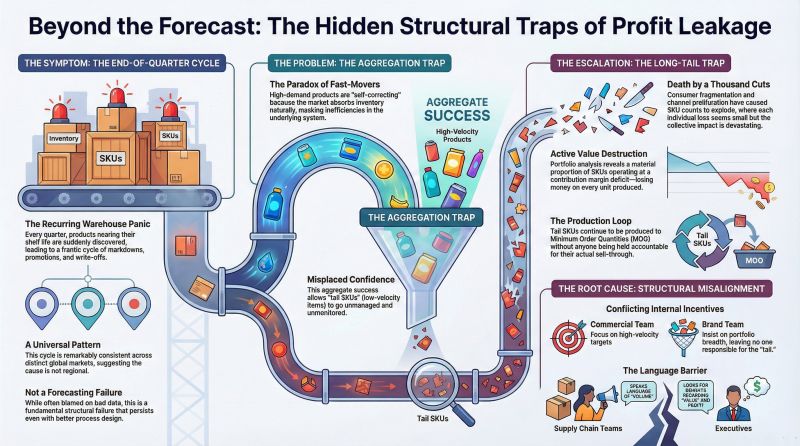
Structural Traps
Planning · Structure

What Consulting Taught Me — and What the Ground Made Me Realise

Profit leakage follows the same structure, wherever you look. The Aggregation Trap and the Long-tail Trap explain why loss-making SKUs survive undetected.
Chapter 1 · Profit Simulation
No-Touch Planning
Planning · Systems

Why No-Touch Planning Still Ends in Spreadsheets

Planning systems do not all do the same job. Some consolidate plans. Others are where plans are actually formed, tested, and reshaped as conditions change. Only the second type moves closer to autonomy.
Chapter 2 · No-Touch Planning
Decision Architecture
Decision · Governance

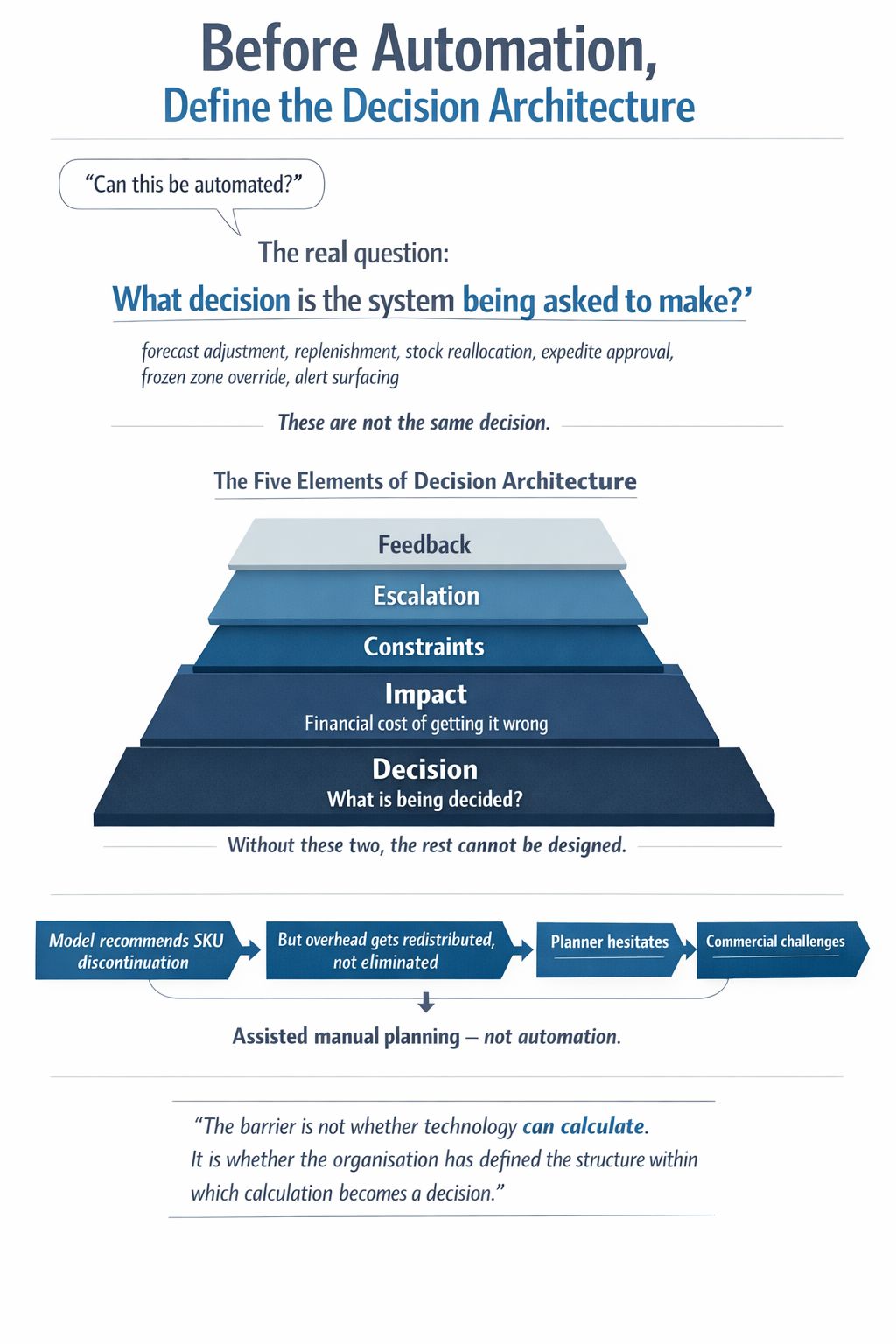
Before Automation, Define the Decision Architecture

A system cannot meaningfully automate a decision that the organisation itself has not clearly defined. Five elements must be explicit before any planning decision becomes operationally credible.
Chapter 2 · No-Touch Planning
Planning vs Intelligence
Intelligence · Platform

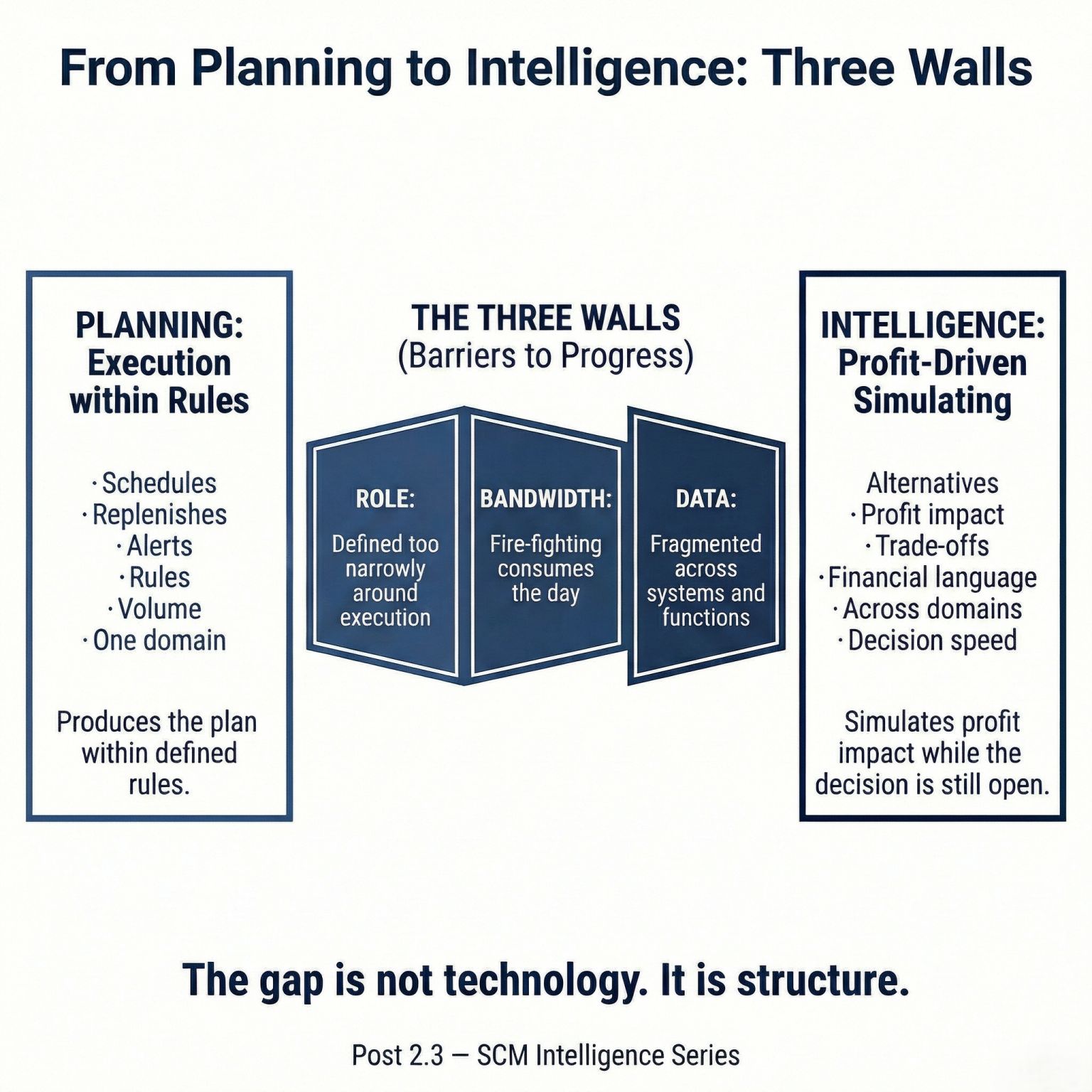
A Planning System Is Not Yet Intelligence

Planning tells you what the rules say should happen next. Intelligence tells you what happens to the margin when rules are broken — and whether breaking them might actually be the right answer.
Chapter 2 · No-Touch Planning
Deletion Trap
Finance · Operations

The Deletion Trap

When a loss-making SKU is removed, the costs it absorbed don't disappear — they redistribute. The upside is capped. The downside is open-ended. Simulation before deletion is mandatory.

Chapter 1 · Profit Simulation

Start with a conversation

Whether you're exploring a profitability diagnostic, evaluating an intelligence platform build, or simply want to discuss structural challenges in your supply chain — we'd welcome the conversation.

🌐 nexenbridge.com

Nex & Bridge designs independent SCM data analytics platforms and simulation environments. We focus on explaining existing operational facts to support clear decision-making — rather than replacing existing operational systems.